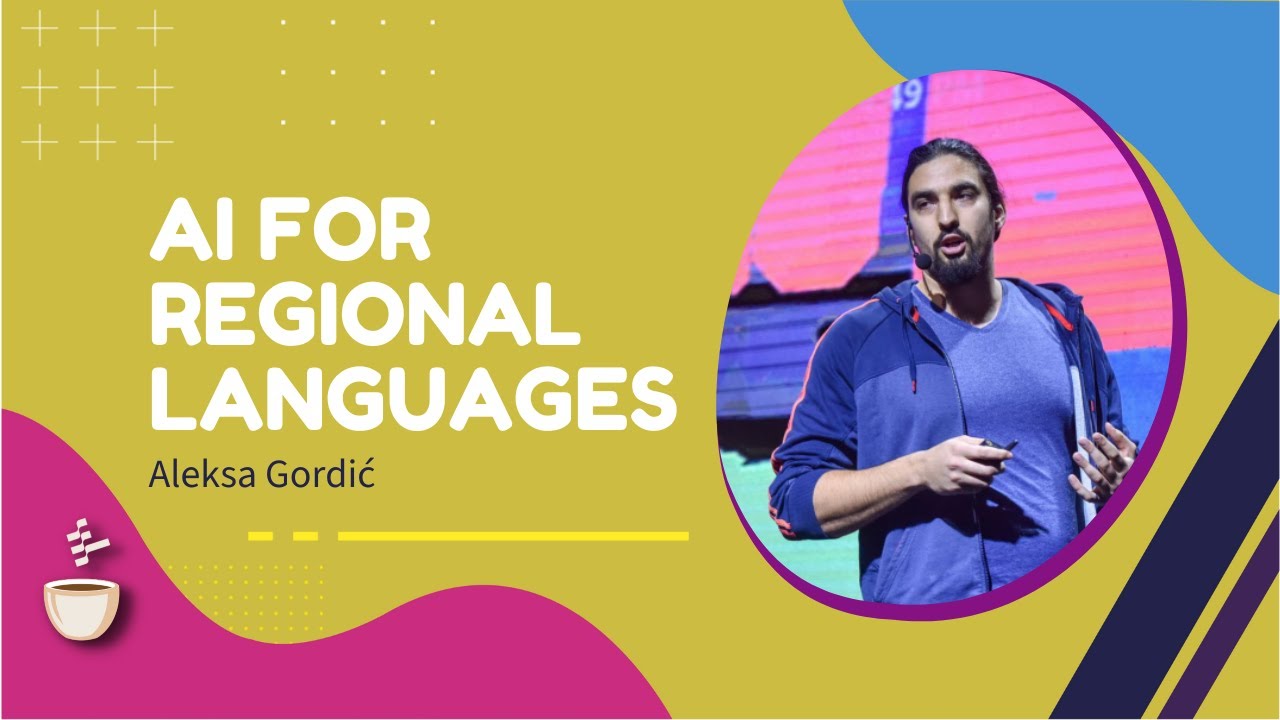
Aleksa Gordić is building YugoGPT for Serbian, Croatian, Bosnian, and Montenegrin because existing language-model support and evaluation resources for these languages are weak.
2
YugoGPT is a general language model, while his open-source No Language Left Behind work is a machine-translation system intended for commercial use.
3
Aleksa chose to build a company instead of taking highly paid big-tech offers because he values agency and believes the possible outcome of a startup is greater than the predictable outcome of a corporate role.
Summary
Aleksa Gordić discusses his work on multilingual AI, his path through Microsoft and DeepMind, and his decision to start OrtusAI. He describes YugoGPT, a language model for Serbian, Croatian, Bosnian, and Montenegrin, and explains why regional languages need more than occasional support from English-first systems. He is also adapting Meta's No Language Left Behind work into commercially usable checkpoints. The technical problems include limited training data, poor tokenizers, weak evaluations, and the difficulty of preserving a model's existing knowledge while teaching it another language. Aleksa also explains how publishing technical work and running an AI Discord led to collaborators, compute grants, and job offers. He is candid about the trade-offs of entrepreneurship, arguing that a corporate salary offers limited agency and caps the possible outcome. He is looking for a technical co-founder who can train large multilingual models at scale.
Aleksa used his own GPU setup to build practical AI applications
Aleksa says he first needed GPUs to run Whisper for a podcast-transcription application based on Huberman's content. He later subscribed to much larger sources, including the Jocko Podcast and MIT OpenCourseWare, which had more than 8,000 videos. His local machine has two RTX 3090 GPUs and 120 GB of RAM. He improved throughput by running Whisper models in parallel and using CTranslate2, a library that optimizes memory use and speed. The difficult part was not only inference. He also had to handle vector databases, post-processing, storage, and the system that returns an answer when a user asks about a YouTube video.
Open-source communities helped Aleksa get compute and collaborators
Aleksa says he used Weaviate for free because he knew its CEO and the company supported his work. Together AI gave him access to 16 A100 GPUs for training an open-source project. He connects this support to a wider pattern in the industry, where companies with unused compute sponsor open-source projects. He also runs an AI Discord where researchers such as James Betker and Tri Dao have given talks. Those relationships helped him learn from specialists and find opportunities. His public technical work has led to offers from Nvidia and OpenAI, as well as a multilingual co-founder who previously worked at Meta.
Building in public gave Aleksa opportunities that follower counts alone would not
Aleksa says the combination of building useful projects and sharing the work publicly is more valuable than simply collecting a large audience. He contrasts technical posts that explain mathematics or papers with posts that repeat AI news. He does not dismiss the latter, since they may serve a different audience, but he prefers writing that reflects direct experience. His own earlier videos explained papers in detail and included an incomplete MLOps series. He says that work created unexpected opportunities because people could see what he was actually building and teaching.
Language-model evaluations can be misleading when test data leaks into training
Aleksa warns that impressive benchmark scores do not necessarily show that a model can reason better than a human. A model may have seen SAT questions or other evaluation data during training and simply reproduce an answer. He describes a paper in which test examples were reformulated with another language model, making duplication harder to detect. Training on those reformulated examples still produced perfect results on the original test. Aleksa thinks model assessment may need arena-style evaluations, where several models compete and people judge their outputs over time. He also mentions chronological datasets such as Bloomberg's financial data as a stronger evaluation setup because future samples can be held out.
YugoGPT targets a region with little modern language-model infrastructure
Aleksa is training YugoGPT for Serbian, Croatian, Bosnian, and Montenegrin. He began after finding that DeepL did not support Serbian and that the available Serbian model was a 750-million-parameter GPT-2-era system. In his view, the region lacked a usable language-model ecosystem, including evaluations and modern models. He wants a model that lets people use generative AI in their native language. He says language is also a business opportunity because a strong English model does not automatically win in Vietnam, Kenya, the Balkans, or other markets with different language needs.
No Language Left Behind and YugoGPT solve different problems
Aleksa explains that his No Language Left Behind work is a machine-translation system, while YugoGPT is a general language model. Translation supports specific language directions. A general model can also summarize documents, retrieve information, and generate text. He says Meta released non-commercial checkpoints for No Language Left Behind, which limited how businesses could use them. His goal is to release commercially usable checkpoints. YugoGPT will be released under Apache 2.0, although he expects the first version to leave substantial room for improvement.
Limited data and poor tokenizers make regional-language training harder
Aleksa says the current YugoGPT training run uses 16 A100 GPUs and will take several more days for one pass through the dataset. He plans to instruction-tune the model and may skip reinforcement-learning alignment initially. He is also using the Llama tokenizer for now, which makes Serbian more verbose at the token level and increases training and inference cost. He wants to build a better tokenizer. More broadly, many languages do not have enough text to train a large model from scratch. His proposed approach is to adapt a strong reasoning model to a new language while preserving its mathematics, facts, and other knowledge.
Aleksa prefers startup agency to a predictable big-tech career
Aleksa says he left Microsoft and DeepMind because he wanted a high-agency role where he could choose what to build and use more of his abilities. He argues that even very large corporate compensation packages look different after taxes and living costs. In his view, the downside of trying a startup is limited: he could raise money, build a team, fail, and later return to a senior corporate role. The upside is much larger than a salary. He is looking for a technical co-founder with experience training large language models at scale, preferably with multilingual work and a publication record.
"The first one, the NLLB, is basically a machine translation system and the second one, the YugoGPT, is a large language model which means it's much more flexible."Aleksa Gordić37:49
Who should watch
You are building language products for a market that is poorly served by English-first models and want to understand the data and tokenizer problems involved.
You are deciding between a senior role at a large technology company and founding an AI startup, and want Aleksa's reasoning about agency, risk, and expected outcomes.
You publish technical work or run an engineering community and want concrete examples of how that can lead to collaborators, compute, and opportunities.