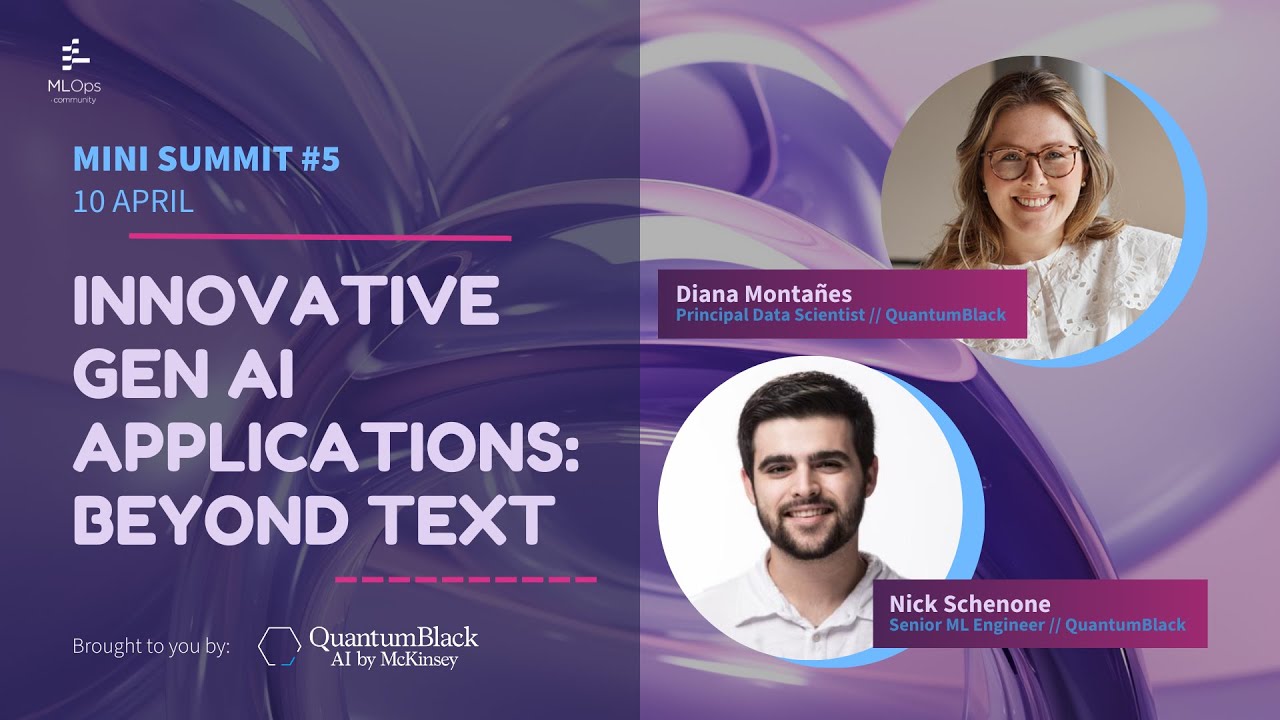
Diana C. Montañes Mondragon explains how chemical language models can generate molecules and predict their properties from molecular representations.
2
Large language models can search scientific literature through retrieval-augmented generation, helping researchers extract chemical information from a large body of papers.
3
Nick Schenone shows how domain knowledge, batching, and parallel processing moved a call-center analysis pipeline toward production on limited on-premises GPU capacity.
Summary
Diana C. Montañes Mondragon discusses generative AI for molecule discovery. She explains how molecules can be represented as strings or graphs, then used with chemical language models for molecule generation and property prediction. The talk also covers retrieval-augmented generation over scientific papers, with an application that extracts possible refrigerants and provides supporting document references. Diana is clear about the limits: generated molecules may be invalid, existing models may produce limited novelty, and scientific language models still need better domain adaptation. Nick Schenone presents a call-center application for a banking client. The pipeline diarizes speakers, transcribes and translates audio, removes personal information, and asks a local language model to produce structured call analysis. Because production ran on premises, the team improved throughput with domain-specific audio handling, CPU-based voice activity detection, batching, and distributed processing across GPUs. The examples show that much of the engineering work sits around the language model.
Molecules can be represented in forms that match different model architectures
Diana C. Montañes Mondragon begins with molecular representations. A string representation records the atoms and their connections as a sequence, which makes it possible to apply ideas from language modeling. A graph representation treats atoms as nodes and bonds as edges, capturing more of the molecule's chemical structure. She says this richer representation gives models more information about how the molecule is organized. These choices affect which models can be trained and what properties they can learn.
Molecule generation still needs chemical validation and more novelty
Chemical language models can generate molecules according to desired properties, although Diana notes that chemists have long proposed molecules through experience and experimentation. In one project, the models produced many nonviable molecules that had to be filtered with chemists using basic rules. She also found that the models were not yet fully innovating beyond known examples. The longer-term aim is to generate novel molecules with selected properties, while incorporating more chemical constraints directly into the models.
Self-supervised chemical models can reduce dependence on small labelled datasets
Property prediction has traditionally relied on engineered molecular features and supervised datasets. Diana points out that laboratory testing is difficult, so labelled datasets are often small, and models trained on one dataset can struggle with molecules from another. Foundational models trained with self-supervision on large molecular collections can first learn general chemical structure, then be fine-tuned for a particular prediction task. She expects larger specialist datasets and architectures that reflect chemistry more closely to improve generalization.
Scientific literature can support molecule repurposing through retrieval-augmented generation
Diana describes using large language models to extract chemical insights from papers, patents, grants, and clinical research. The system processes the sources into a vector database, embeds a user's question, retrieves relevant passages, and gives them to a language model as context. In the demonstration, a query asks for chemical substances that could serve as refrigerants. The application returns names, retrieved document identifiers, document chunks, and a hallucination score. Diana says visual information in scientific papers will also need to be handled.
A call-center pipeline turns raw audio into structured analysis
Nick Schenone presents a banking use case built from historical customer-service calls. The pipeline first identifies which speaker is talking, then transcribes and translates the audio, removes personal information, and sends the anonymized text to a language model. The output includes the call topic, a summary, whether the concern was addressed, the tone of the customer and agent, whether an upsell was attempted, and subjective measures such as professionalism and active listening. The resulting structured data can populate databases and support later applications.
Production constraints changed the choice of models and infrastructure
The banking client's development environment was in Azure, while production had to run on premises for regulatory reasons. The same tooling therefore had to work in both environments. The production system could not rely on hosted API models and had a limited pool of GPUs, so it used open-source models and had to use the available hardware efficiently. Nick stresses that most of the pipeline was data preparation rather than language-model work, including diarization, transcription, translation, and personally identifiable information recognition.
Audio domain knowledge made diarization much faster
The team first tried PyAnnote for diarization, but it was heavy and processed one audio file at a time. They then used knowledge about call-center recordings: one speaker is stored on the left audio channel and the other on the right. This allowed them to switch to Silero VAD, a CPU-based voice activity detection model, and use multiple CPU cores. The specialized approach did not apply to every type of audio, but for these recordings it made the pipeline step 60 times faster and freed GPUs for other work.
Batching and distributed processing improved Whisper utilization
The original Whisper transcription step also underused the available hardware. A model copy processed one audio file at a time, and allocating multiple GPUs did not automatically make the model use them. The team added batching so each model copy could handle several files, then used Horovod on Open MPI to divide chunks of audio among workers. Each worker had a copy of the Whisper model, and each copy processed multiple files. This two-level approach increased GPU utilization to roughly 100 percent and sped up the transcription stage.
"What we would like to do and to further expand the molecule discovery is to be able to repurpose these molecules or these materials to be able to use them in other domains where they are relevant."Diana C. Montañes Mondragon17:53
Who should watch
You are building AI tools for pharmaceutical, chemical, or biotechnology research and need examples beyond generic text generation.
Your application has scientific documents, small labelled datasets, or molecular data that needs a domain-specific modeling approach.
You are moving a generative AI prototype into production with local models, limited GPU capacity, audio processing, or strict data-handling requirements.