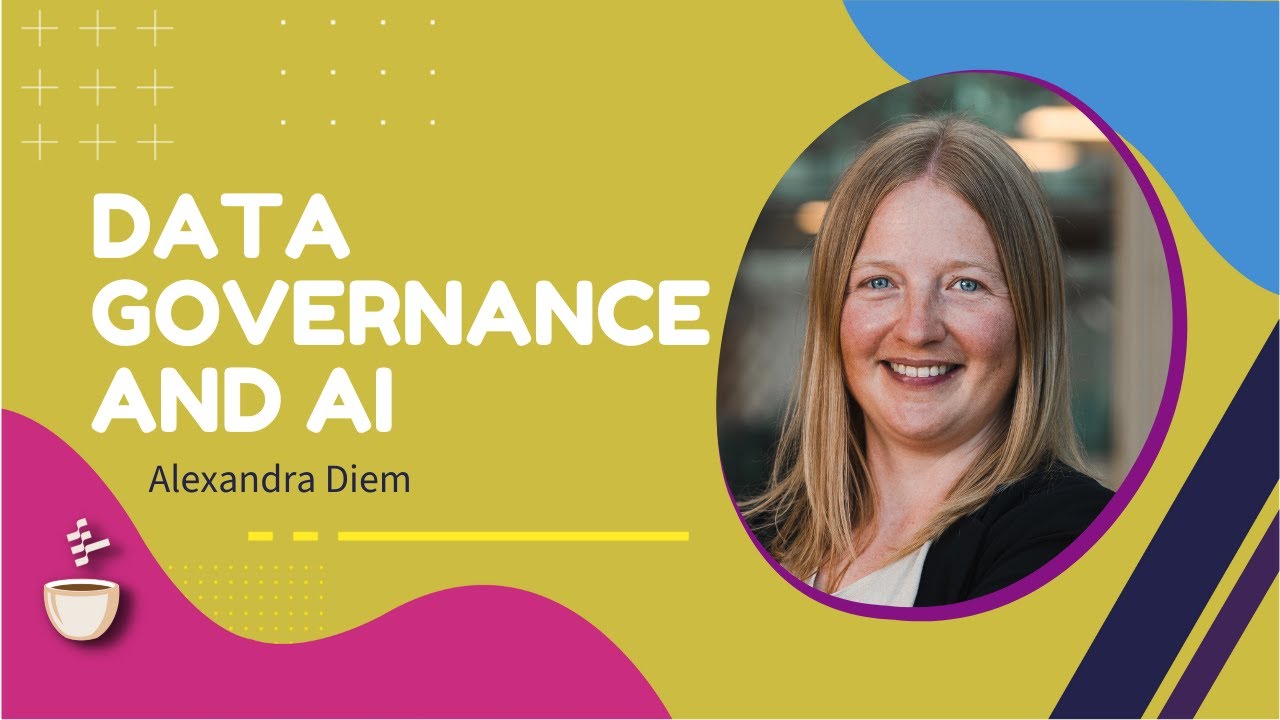
Alexandra Diem's enabling team works with analytics teams on minimum viable products, teaches production practices, then leaves ownership with the business team.
2
Gjensidige is cautious about generative AI products because sensitive customer data requires clear controls over where data goes and how it is used.
3
Her team tests internal, specialized AI applications first, including natural-language SQL and search over internal documents, before using AI in customer-facing workflows.
Summary
Alexandra Diem describes how she moved from applied mathematics and biomedical research into consulting and then into her role leading cloud analytics and MLOps at Gjensidige. Her team is an enabling group that joins business analytics teams temporarily, helps them ship an end-to-end minimum viable product, teaches software engineering practices, and leaves the team able to maintain its own solution. She argues that hypothesis testing and early production delivery prevent data scientists from spending too long exploring data without proving business value. Gjensidige also has to be careful with generative AI because it handles sensitive information about the Norwegian population. The team therefore focuses on internal use cases, such as natural-language database queries and search through internal documents, while comparing self-built applications with cloud-native services. Diem is candid about change management, tool choice, project scope, and the need to respect the work teams have already put into their systems.
Diem's route from academic research to production data work shaped her engineering approach
Alexandra Diem began in bioinformatics and applied mathematics, then completed a PhD focused on medicine. She expected to become a professor, but the temporary nature of postdoctoral work made that path unattractive, especially as she became attached to living in Norway. Consulting became her entry into tech. Because her consultancy had not yet found a data science contract, she first worked on software development projects. She then applied those methods to data science clients and later joined Gjensidige to lead a team focused on bringing software development practices into data work.
Biomedical modelling taught Diem to test assumptions with the smallest useful experiment
During her PhD, Diem studied how amyloid beta waste is cleared from the brain. She used equations and computer simulations to challenge the theory that arterial pulsations alone drove this clearance. Her results suggested that the pulsations were not strong enough and that tiny muscle cells in artery walls could provide another factor. She described science as a process of proposing a theory and trying to disprove it. That same approach now appears in her data work: write the minimum amount of code needed to test a hypothesis, put it into action, and iterate.
Production habits protect data teams from unmaintainable work
Diem says data scientists often know how to write Python scripts but have not been taught how to collaborate with code or write code they can understand months later. Clean code, production readiness, and collaboration practices reduce the risk that a model becomes impossible to maintain when someone goes on holiday or leaves the company. She also stresses the difference between building the thing right and building the right thing. A technically accurate model still has little value if it solves the wrong business problem.
Stakeholders and hypotheses stop projects from getting trapped in exploration
In her first data science consulting project, Diem was given a client that did not know what it wanted from a data scientist. The work could have remained in data exploration indefinitely. The team started generating value only after switching to hypothesis-based testing and involving the customer closely. Diem now brings stakeholders in from the beginning and develops several hypotheses with the person who owns the business value of the model. The model owner might be a sales centre using leads generated by a model, rather than an abstract technical user.
The enabling team measures success by becoming unnecessary
Diem's team does not own the models it helps build. It forms temporary collaborations with analytics teams inside business units, often pairing two people from each group. Together they build a minimum viable product, while Diem's team teaches clean coding and code collaboration. The analytics team then owns and maintains the solution, and the enabling team moves on. Diem describes the team's main goal as making itself redundant every time it works with an analytics team.
A recommended toolset helps teams avoid falling back to familiar tools
The large number of available tools creates its own problem. Diem says people may return to something familiar, such as Excel, because choosing among many alternatives is difficult. Her team studies the available technology stack and recommends a set of tools. It also builds a network of super users who can help colleagues. Teams do not all have to use identical tools, but people who do not know where to start can use the recommended options and find examples from similar work elsewhere in the company.
Internal knowledge sharing exposes reusable solutions across business domains
Gjensidige keeps models with the analytics teams in the business domains, which means around 20 teams can work on separate problems. Those teams may not know what one another is doing. Because Diem's group moves between teams, it can spot repeated problems and connect people who have already solved similar issues. One team might learn that another group in commercial insurance faced the same problem and used a solution that could be adapted. This reduces repeated work without removing ownership from the domain teams.
Generative AI stays internal until data governance is clear
Diem says generic generative AI features in other products are difficult to buy because vendors often provide too little detail about data governance. Gjensidige has sensitive information about the Norwegian population and its customers, so the company needs to know what happens to its data and where it is sent. The team requested access to GPT models hosted within Azure, its chosen cloud provider. Its current applications are specialized internal chatbots, including natural-language SQL for business developers and a retrieval-augmented search tool for customer advisors.
End-to-end MVPs reveal the route before a team builds the full system
For a profitability forecasting project, Diem's team is changing the usual sequence of completing every data transformation, then every model, then every visualization. It takes one insurance product through the whole process from end to end, then chooses another product, probably the trickiest one, and repeats the process. This exposes the difficult parts early. If the allocated time runs out, the analytics team still knows how to finish the work. Diem compares the approach to giving a customer a skateboard before a bicycle or a car. The first version must work, and later improvements should be added only when they are needed.
"When your customer wants a car, then you're not going to give them a wheel first or a set of two wheels. What you're going to give them first is a skateboard."Alexandra Diem1:00:32
Who should watch
You lead a data platform or enabling team and need a practical model for helping domain teams ship work without taking ownership away from them.
Your data scientists spend too long in notebooks or exploration and need a way to test business hypotheses in production earlier.
You are assessing generative AI for sensitive internal data and need examples of lower-risk use cases plus questions about governance.