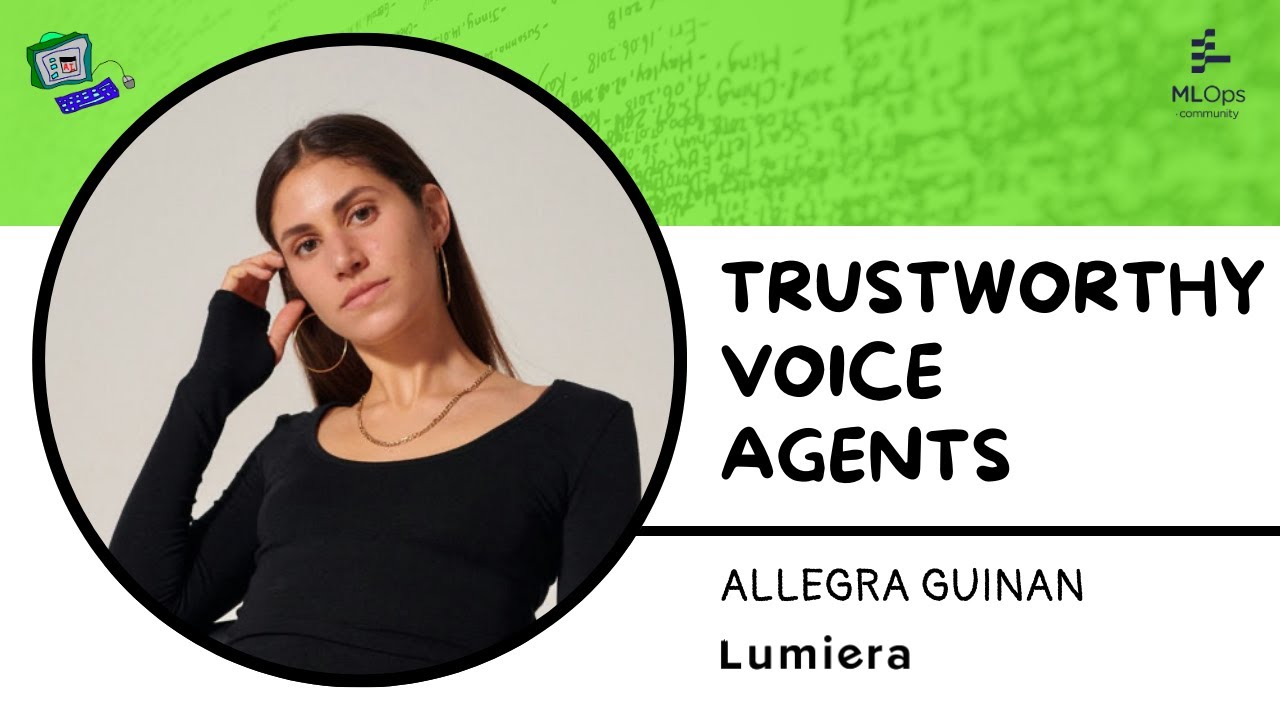
Voice agents need deliberate choices about voice, architecture, latency, conversation design, and security because users place unusual trust in spoken interactions.
2
A frontline conversational agent should delegate focused tasks to specialized backend agents instead of trying to handle every capability in one large prompt.
3
Trust depends on visible security, clear data-use policies, useful feedback, and consistent recovery when the system makes mistakes.
Summary
Allegra explains why voice agents need different design choices from text-based agents. She describes modular systems that convert speech to text, use an LLM, and convert the response back to speech, while warning that speech-to-speech systems can reduce latency while remaining less mature. The talk covers five misconceptions. Voice selection can reinforce gender stereotypes and affect perceived competence. A single agent with a large prompt can lose track of tasks, so a conversational frontline agent should delegate focused work to specialized backend agents. Voice systems must respond quickly or explain what they are doing during delays. Text content cannot simply be read aloud because spoken interaction includes accents, interruptions, filler words, and background noise. Finally, trust is not automatic. Clear data policies, careful logging, feedback mechanisms, human fallback, and visible security help users understand and control what happens.
Voice agents turn speech into actions through modular or speech-to-speech systems
Allegra defines a voice agent as a system that listens, understands, decides, and responds in natural language. In a common modular architecture, speech-to-text converts the user's words into text, an LLM interprets them, and text-to-speech produces the spoken response. Newer speech-to-speech models remove the middle text step and can reduce latency, but Allegra says they are less mature and more susceptible to problems. She also warns that voice agents are not simply text agents with a voice added.
The voice must fit the role and support more than one narrow identity
Users make unconscious judgments from an agent's voice, including its pitch, speed, confidence, and hesitation. Allegra says common defaults such as female names and voices can reinforce the association of female voices with cooperation and male voices with authority. She recommends customizable or gender-neutral options, support for varied accents and dialects, and adapting voice characteristics to interaction patterns. The voice also has to fit the job. A supervisor and a helpful assistant carry different expectations, and a mismatch can make the system seem less competent.
Delegation keeps conversation management separate from specialist work
A single large prompt may work at first, but in production agents can get stuck chatting, lose their place in multi-step tasks, and become harder to extend safely. Allegra recommends a delegation architecture with a frontline agent that manages the ongoing conversation and uses tool calls to reach specialized backend agents. Teams should break broad tasks into small goals such as identifying intent or collecting required information. She also advises starting with limited tools and adding capabilities as real conversation patterns become clear. Conversation management and domain expertise require different skills.
Voice systems need immediate feedback during tool calls
Silence during processing makes users unsure whether the system heard them. They may repeat themselves or interrupt, which can create further problems. Allegra says natural conversation requires a response in under a second, while also distinguishing perceived responsiveness from actual processing speed. An agent can take longer if it tells the user what is happening, with phrases such as, "Let me check on that for you" or "I'm looking up your account information." Model choice, audio streaming, and edge deployment can help reduce latency, but communication during the wait matters most.
Existing FAQs and text conversations cannot be transferred directly into a voice interface because people do not speak as they write. Voice design must account for intonation, accents, filler words, background noise, and unexpected turns. Allegra recommends training with real conversations involving human agents, testing varied conditions, and giving the system ways to recover from misunderstandings. A failing-forward approach can guide the user back to the goal instead of ending the interaction. She also says users may give clearer, more specific requests when they do not expect the AI to be perfect.
Trust has to be made visible through security and feedback
People may trust voices more than text, but that does not mean they automatically trust a voice assistant. Allegra says users need clear policies about data use and careful handling of sensitive information in logs. Repeated mistakes damage trust, so systems need to improve over time through intentional feedback mechanisms. Her closing recommendations are to support diversity, use specialized architecture, show appropriate uncertainty, design for spoken conversation, and make security transparent.
Clear goals and human fallback control difficult customer conversations
In the question period, Allegra addresses callers who are confused, frustrated, or need a walkthrough. She recommends training on actual conversations and using clear goals that guide the caller toward the information or action required for a tool call or form. Fallback mechanisms and a human in the loop should always be available. She also suggests a complementary agent that monitors the conversation for drift and can trigger intervention when the interaction goes off track.