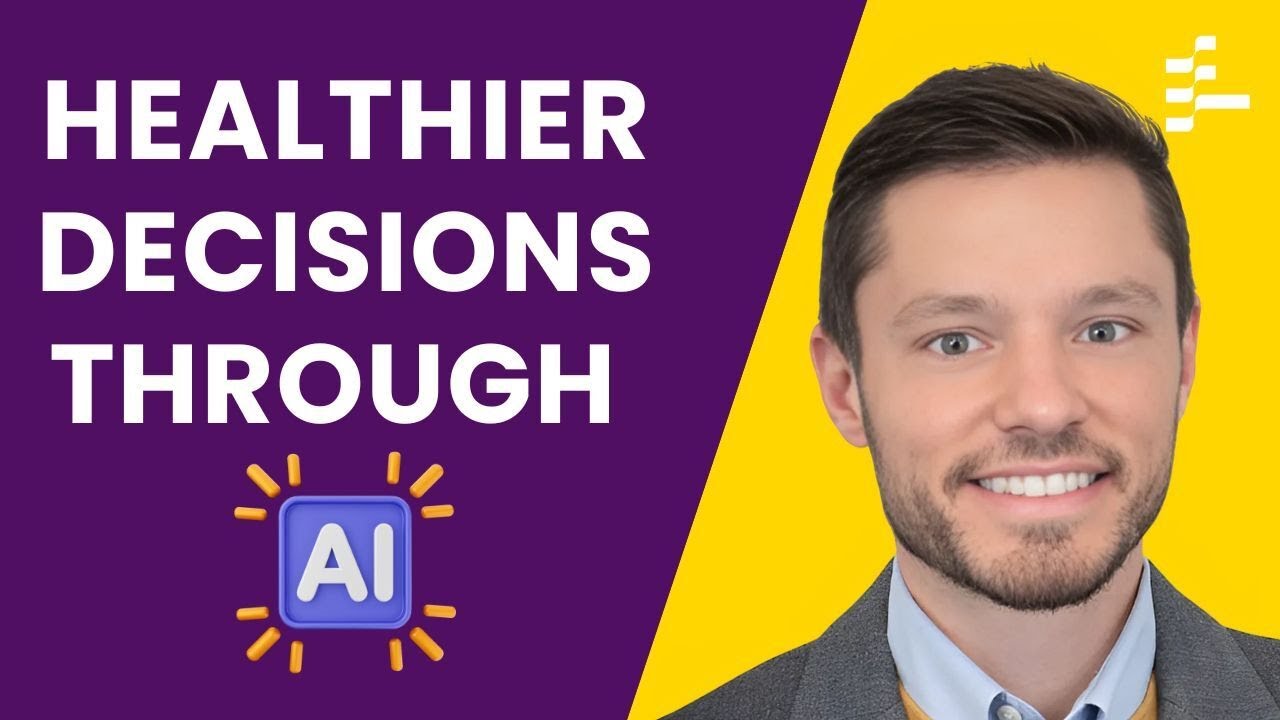
David Cox uses behavioral science and machine learning to study the environmental signals that shape human decisions.
2
Unsupervised machine learning can identify patient and student groups that need different interventions or resources.
3
Useful AI systems need rich behavioral context, controlled outputs, and products that fit the work of clinicians and teachers.
Summary
David Cox discusses AI through the lens of behavioral science rather than LLMs. His work examines how environmental signals, wearable data, clinical observations, and other behavior records can explain why people make certain choices. The goal is to help people choose healthier actions and help clinicians make better decisions. Cox explains how reinforcement learning concepts, the matching law, contingency management, and just-in-time adaptive interventions can guide these systems. In healthcare, unsupervised learning can find patient profiles, while supervised learning can recommend actions for specific clinical goals. He also describes similar uses in education, where learner behavior and assessment data could help teachers match students with appropriate resources. Cox is candid that data collection is the hard part. Daily life requires a broad view of context, while clinical settings provide more controlled data. He also argues that many of these applications need transparent, discriminative systems rather than probabilistic LLM outputs.
Behavioral data can explain choices that people cannot accurately describe
Cox came to AI from behavioral science, where he studied how changing a person's environment can change their behavior. He wants to combine information from sensory modalities, wearable technologies, and other environmental data to understand why people act as they do. A person's explanation is not always a reliable account of their behavior. Cox uses the example of someone who says they eat broccoli but whose data shows a preference for pizza. He connects this to the antecedent-behavior-consequence chain, where events before and after an action help reveal what reinforces it.
Healthy habits can be changed by making their rewards compete with existing habits
Cox applies the matching law to everyday behavior. People tend to spend time on activities in proportion to the reward they receive from them. If someone spends hours on Netflix and little time walking, an intervention can add rewards to physical activity so it competes with the existing behavior. He describes contingency management, such as paying someone for reaching a step count. Research can produce changes in physical activity for less than a dollar a day, but the harder question is whether the activity becomes intrinsically rewarding after the extra incentive is removed.
The data needed for personal behavior change is difficult to collect
A system that helps someone change daily habits would need a broad view of their life, including activity, sleep, screen time, and other routines. Cox has tracked his own time from waking to sleeping for 15 years and has combined Whoop data with custom scripts and data from Strava and Peloton. Even with those tools, gaps remain. Clinical settings are easier because the therapist controls the context and knows what behavior is being measured. Everyday life is much less structured, and people rarely provide unrestricted access to all the data needed for a complete picture.
AI can support clinical decisions through different types of machine learning
In healthcare, Cox describes a progression from unsupervised to supervised learning. Unsupervised models can identify patient cohorts or profiles from clinical presentation data. Those groupings can inform how a clinician intervenes. Supervised learning can then estimate what action may move a patient toward a desired outcome. A single patient may have 10 or 20 goals, which creates more complex systems involving multiple models, ensembles, and hierarchical decision structures. Cox says these systems need to be controlled, compliant, transparent, and discriminative. Probabilistic outputs can be dangerous in healthcare when the system must be very good at a specific task.
Behavioral data can reveal relapse before a person recognizes it
Cox says a person may sincerely believe they have changed even when their behavior only shows a short-lived spike. Collecting behavior data allows a therapist to compare what someone reports with what they actually do. Relapse can be treated as a time-series forecasting problem. The system can look for combinations of environmental variables that predict a return to an older behavior pattern. A therapist could then add resources or other support before the relapse occurs. Cox compares the idea to a Minority Report-style prediction, while acknowledging that the concept can be used for harmful manipulation as well as for health.
Small changes in effort can make unwanted actions less attractive
Cox describes self-management strategies that change the effort or delay associated with a behavior. Putting a phone across the room makes it harder to start scrolling after getting into bed. Demetrios Brinkmann describes shutting off his phone before reading to his children, which creates enough friction to make reading easier than restarting the phone. Cox says people generally choose the less effortful option, so changing the arrangement of the environment can shift behavior without relying entirely on willpower. A system could use data to find which environmental changes have the greatest effect for a particular person.
Some behaviors are keystone contingencies with effects across the day
Cox and colleagues are developing the idea of keystone contingencies, drawing on the ecological idea of a keystone species. A keystone behavior is one change that causes other parts of a person's routine to reorganize. Cox gives his own morning running as an example. When he runs in the morning, he drinks less alcohol the night before, eats better, and focuses more at work. The behavior does not make him perfect, but it has effects across several areas. Identity can also change the value of an action. Calling oneself a runner or a smoker can affect which behaviors feel consistent with that identity.
Education systems need behavioral context before machine learning can personalize support
Cox describes work with glimpse K12 that used patterns such as assessment scores to identify students who may need additional resources. Online learning platforms can provide richer data by recording when students log in, what they engage with, how long they read, assignment quality, grades, and teacher feedback. That information could support personalized instruction instead of giving every student the same tasks. Cox also discusses research using cameras, iPads, and computer vision to capture behavior in classrooms, though he has not seen this become a widely offered product. The main obstacles are collecting the right data and making the return on investment work for schools.
"We understand behavior by understanding that larger context within which it behaves."David Cox39:36
Who should watch
You are building behavior-change products and need to think about rewards, friction, relapse, and the data required to personalize interventions.
Your healthcare or education system has machine learning ideas but lacks a clear plan for collecting behavior data and presenting useful recommendations to practitioners.
You are interested in AI applications beyond LLMs, especially unsupervised learning for finding patient or student groups.