AI in education works best when it is shaped around a learner's existing knowledge, curriculum, and needs.
2
The panelists have found that generating useful teaching material requires more work than generating factual content or generic answers.
3
At large scale, teams need constrained workflows, pre-generation, smaller models, or generated rules because running an LLM for every learner interaction is expensive.
Summary
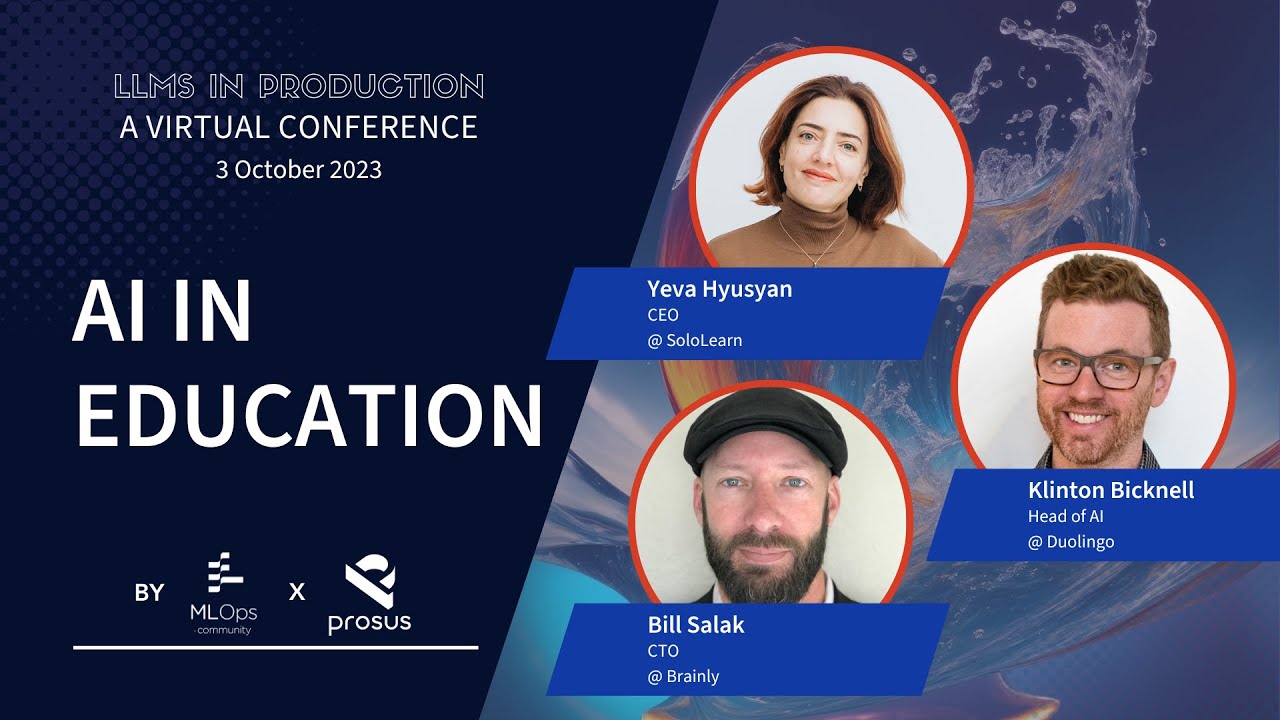
This fireside chat examines how Duolingo, Brainly, and SoloLearn are using AI in learning products. Yeva Hyusyan describes work on models that produce content in ways that teach, with teachers providing feedback. Bill Salak explains why Brainly constrains models with trusted context and learner information, rather than treating an LLM as a source of facts. Klinton Bicknell discusses interactive language practice, explanations, curriculum generation, and the cost of operating models at scale. The panelists agree that a generic assistant is unlikely to differentiate an education product. The harder work is adapting explanations, conversations, and exercises to what a learner already knows. They also discuss using LLMs offline to pre-generate options or create inexpensive rules that can run in real time. The conversation ends with cautious optimism about interactive learning and education systems that cannot provide enough individual attention.
Education companies are trying to make AI teach, rather than only generate content
Yeva Hyusyan says SoloLearn has spent the past year and a half testing AI in its learning experience. The company has already put an AI assistant into production and discontinued experiments that did not work. Her larger focus is teaching models how to produce material in a format that actually teaches. She argues that EdTech has spent much of the past decade putting more content online, often by reproducing a classroom experience digitally. AI could support tutors, personalized learning, skill practice, and books that help with social and emotional intelligence. The difficult part is encoding the teaching quality behind those experiences, not simply producing more lessons.
Personalized explanations need to match what a learner already knows
Bill Salak describes Brainly as a community learning platform where learners get help with school subjects and grades. Its AI work focuses on explanations that resemble what a learner's teacher might give. That means considering the vocabulary used in the learner's classroom and the concepts the learner has already encountered. An answer can be factually correct and still fail if it introduces unfamiliar language or ideas. Brainly combines AI with community contributions, aiming to help learners get unstuck while keeping the explanation appropriate for the individual. The product goal is closer to a one-to-one tutoring exchange than to an answer generator.
A generic assistant is unlikely to become a differentiated education product
Yeva Hyusyan says SoloLearn initially entered AI because everyone was discussing it, but the company learned that another general assistant would not create a lasting advantage. SoloLearn's founding idea was to make difficult things easy to understand, so its current content work uses that teaching purpose as a guide. Teachers provide feedback on small pieces of content, and the system is trained from that feedback. The team started with theory, then moved to simple practice exercises. Hyusyan says the opportunity is in automating what the company understands about how people learn. Bill Salak makes a related point: a company's own data and knowledge about its learners can distinguish its product from generic model capabilities.
Constrained model workflows are safer than asking an LLM to invent answers
Bill Salak says Brainly had low expectations when it began exploring LLMs. The strongest results came when the model synthesized information supplied by the company, rather than acting as a fact-generation engine or general body of knowledge. Brainly first used tightly constrained features such as asking the model to simplify an existing explanation or explain it in more detail. The system already had the question and trusted answer, so the model changed the presentation. Only later did the team move into retrieval augmented generation. Salak says understanding learner behavior, curriculum, content, and knowledge-base patterns allows Brainly to add better context to prompts, though doing that well is difficult.
Operating LLMs at education scale requires work outside the request path
Klinton Bicknell says Duolingo has found it difficult to run large language models naively at scale because even cheaper models can become too expensive when applied to every user response. The team instead looks for uses that do not grow directly with usage. One approach is to have a model pre-generate many possible options and select among them later. Another is to use an LLM to generate inexpensive rules, such as detectors for a particular grammatical error, then run those rules without the model in real time. The panel also discusses generating and ranking responses separately, since selecting among candidates can require less work than generating them.
Interactive learning needs product design as well as better models
Bicknell sees language practice as an area where AI enables experiences that were previously unavailable, such as repeatedly practicing how to order coffee in another language. However, making a chatbot is easier than making an interactive product that learners want to use every day. Duolingo is working on goal-directed conversations, including ordering a drink or helping a tourist find a passport. These conversations need to fit the company's characters and personalities, teach the intended topics, and use language that matches the learner's level. A simple prompt asking for a third-grade reading level is not enough. Fine-tuning helps, but the product experience and the underlying language controls both require substantial work.
The panel sees education access as the larger opportunity
Bill Salak is most excited by the possibility that AI will become accepted in parts of life where people have been reluctant to use it, including classrooms and interactions with children. He points to underfunding, understaffing, and the lack of one-to-one attention as persistent problems in formal and informal education. In his view, these are areas where the technology could help. Yeva Hyusyan is more cautious about the timing. She expects the systems to need continued tuning, trial and error, and learning from use. She connects that work to the need for people to keep learning and upskilling. The panel ends with optimism tempered by the amount of work still required.
"If you're relying on the LLM as a fact generation engine or you're looking at it as a body of knowledge, that's where you're going to find disappointment."Bill Salak12:12
Who should watch
You are building an education product and need to decide where an LLM can add teaching value beyond a generic assistant.
Your model costs are becoming difficult to control as usage grows, and you are considering pre-generation, smaller models, or rule-based inference.
You care about adapting explanations or practice to a learner's current knowledge and curriculum.