Stack Overflow licenses its curated Q&A data to AI companies while requiring attribution back to the original sources.
2
The site is expanding beyond canonical Q&A into discussions, live expert chat, coding challenges, and AI-assisted search.
3
Stack Overflow's enterprise product gives companies a curated internal knowledge base that can supply context to AI assistants and agents.
Summary
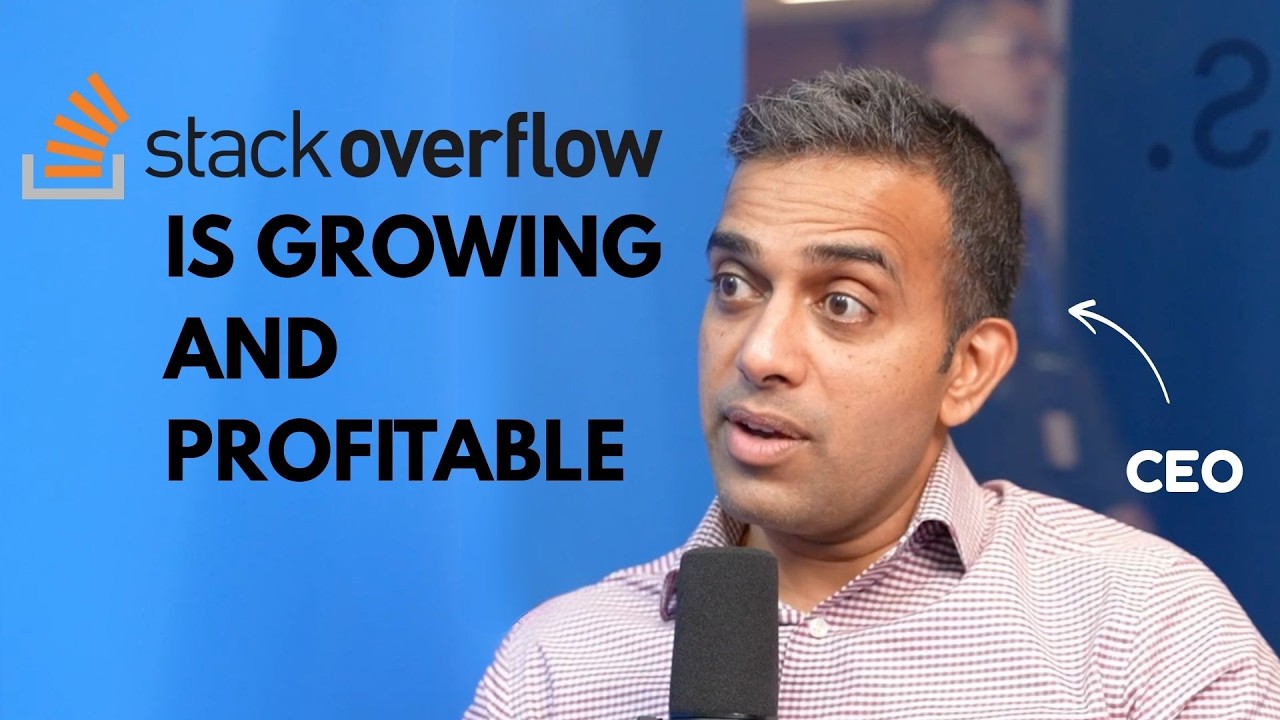
Prashanth Chandrashekar explains how Stack Overflow is adapting as developers use AI tools for more coding questions. Basic questions are increasingly handled by chatbots, while the site's Q&A is receiving more specific and difficult problems. Stack Overflow licenses its data to AI providers, requires attribution, and is building tools that bring its corpus into the places where developers work. The public site is also adding discussions, live expert chat, and other formats for questions that need opinions rather than one canonical answer. Chandrashekar says the company is avoiding a rush to build its own LLM or coding IDE. It sees its advantage in trusted, human-curated knowledge. That approach also drives the enterprise business, where private Stack Overflow instances collect and maintain company knowledge, then provide it to internal search tools and AI agents. The discussion covers falling trust in AI output, the need to learn programming fundamentals, and the way newer technologies first appear in Stack Overflow questions.
Stack Overflow's curated answers remain useful training and evaluation data for AI companies
Chandrashekar says Stack Overflow has kept its quality bar high to create a cumulative corpus of reliable technical knowledge. AI labs used the data to train models, and Stack Overflow later moved toward official licensing after adding anti-scraping measures. Attribution is part of the license, so AI providers must point users back to the original sources and recognize the contributors. He also describes a model fine-tuned on Stack Overflow data through ProLM.ai, which is used to rate foundational models on coding tasks.
AI handles routine coding work until it reaches a context-specific complexity cliff
Chandrashekar argues that AI is useful for removing menial coding work, but it eventually reaches questions that require unusual context or a problem nobody has documented yet. Those cases produce new, viable answers on Stack Overflow. The company's goal is therefore to put its knowledge where developers already work. Stack Overflow is building partnerships that let users ask questions from AI tools and send them back to detailed answers, with attribution. Its own Stack Overflow AI feature can import an LLM conversation, search a corpus of 50 million questions and answers, and direct unresolved questions to Q&A, discussions, or live chat.
Canonical Q&A and open-ended discussion need different formats
Stack Overflow historically closed many duplicate questions to build a library of canonical answers. Chandrashekar says the site is now broadening its mission beyond that format. Hundreds of live chat rooms let users ask human experts for help, including on newer AI topics. Discussions handle questions such as which coding tool to choose and what the trade-offs are between alternatives. Q&A remains the place for an accurate answer that can be accepted and updated, while discussions make room for disagreement, context, and opinions.
The site's Q&A is getting harder questions as AI answers simpler ones
Chandrashekar says the questions that remain in Q&A are increasingly specific, complex, and related to AI technologies. He mentions areas such as NVIDIA CUDA and TensorFlow, alongside newer technologies that developers are learning. Simpler questions can still appear in chat and discussions. He also argues that developers should learn fundamentals, using the example that someone should know 2 plus 2 is not 6 even when using a calculator. Stack Overflow is intended to support both foundational learning and advanced technical work.
Stack Overflow is prioritizing its knowledge layer over building a competing coding agent
When asked why Stack Overflow has not built a product like Cursor or Windsurf, Chandrashekar says the company believes the LLM market is becoming commoditized and the best interface for coding assistance is still unsettled. Developers can switch between tools easily, so Stack Overflow is focusing on the part it understands best: trustworthy knowledge from experts. Its public AI features combine that knowledge with AI search and discovery. He leaves open the possibility of more task-oriented products later, but says they are not the current focus.
Developer adoption of AI is rising while trust in its output is falling
Chandrashekar shares early findings from Stack Overflow's 2025 developer survey. He says the share of users adopting AI for coding tasks rose from about 60% three years earlier to about 80%. During the same period, the share trusting AI output fell from 40% to 29%. He connects this gap to inaccurate or poor-quality generated code and to the spread of AI-generated content. Stack Overflow's response is to emphasize human curation, validation, and a community that maintains high standards.
The enterprise product turns company knowledge into context for AI assistants
Stack Overflow for Teams is used by thousands of companies as a private knowledge base. It gathers information from other sources, identifies subject-matter experts, and keeps answers current through a process modeled on the public platform. Chandrashekar says customers are using its APIs to power internal search and AI assistants. He gives Uber Genie as an example: it uses Uber's internal questions and answers to respond to employee questions in Slack. The value is both faster access to information and retention of expertise when people change teams or leave the company.
Trusted internal knowledge can give agents the context they lack
Chandrashekar says enterprise customers use Stack Overflow's internal knowledge because their experts have worked to keep it accurate. Connecting that source through an MCP server can provide a knowledge stream to an assistant or an agent that performs actions. He describes this as a response to the practical requirements companies have discovered around AI deployment, including privacy, security, and dependable data. Internal documentation also reduces the risk that important knowledge disappears when an employee leaves.
Experienced developers are more skeptical of AI than newer developers
Chandrashekar says Stack Overflow's survey found that trust in AI tends to fall as programmer experience rises. He suggests newer developers may move quickly toward agent tools, while experienced developers spend more time checking language choices, libraries, and how a solution fits with the rest of a system. His advice is to do both: use AI tools while learning the fundamentals needed to judge their output.